
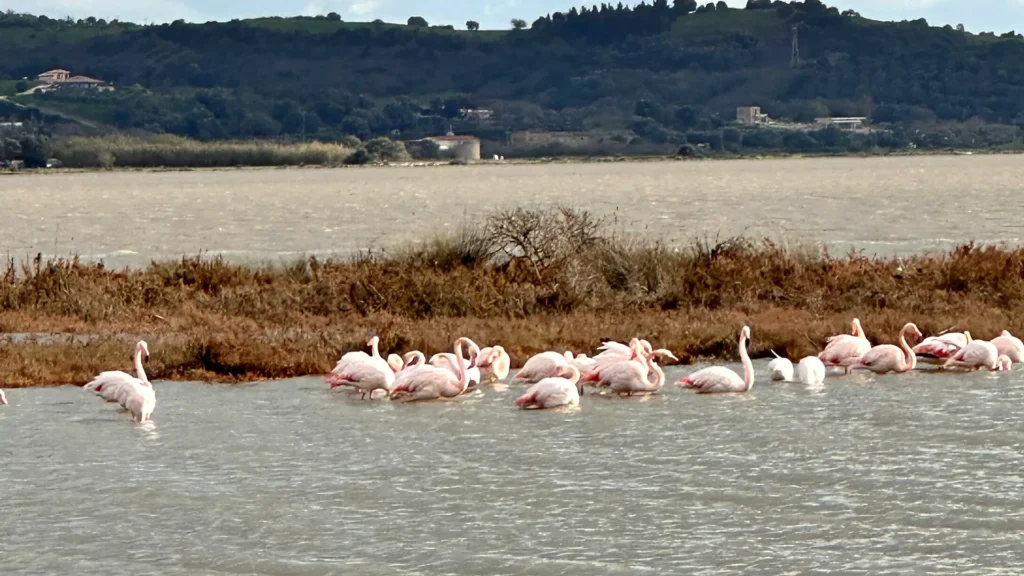
The light was changing fast. A heavy winter sky was breaking apart, and under it, in a shallow lagoon at the northern tip of Lefkada, the flamingos were running.
In short
- The place: the lagoons at Lefkada’s northern edge, near the fortress of Agia Mavra.
- What we saw: greater flamingos, pink and pale, feeding and taking off.
- Best time: the cold months, from autumn into the new year. Afternoon light is best.
- How long: about an hour to watch. A morning or afternoon if you want to walk.
- Cost: free.
- Please: keep your distance and leave the drone at home.
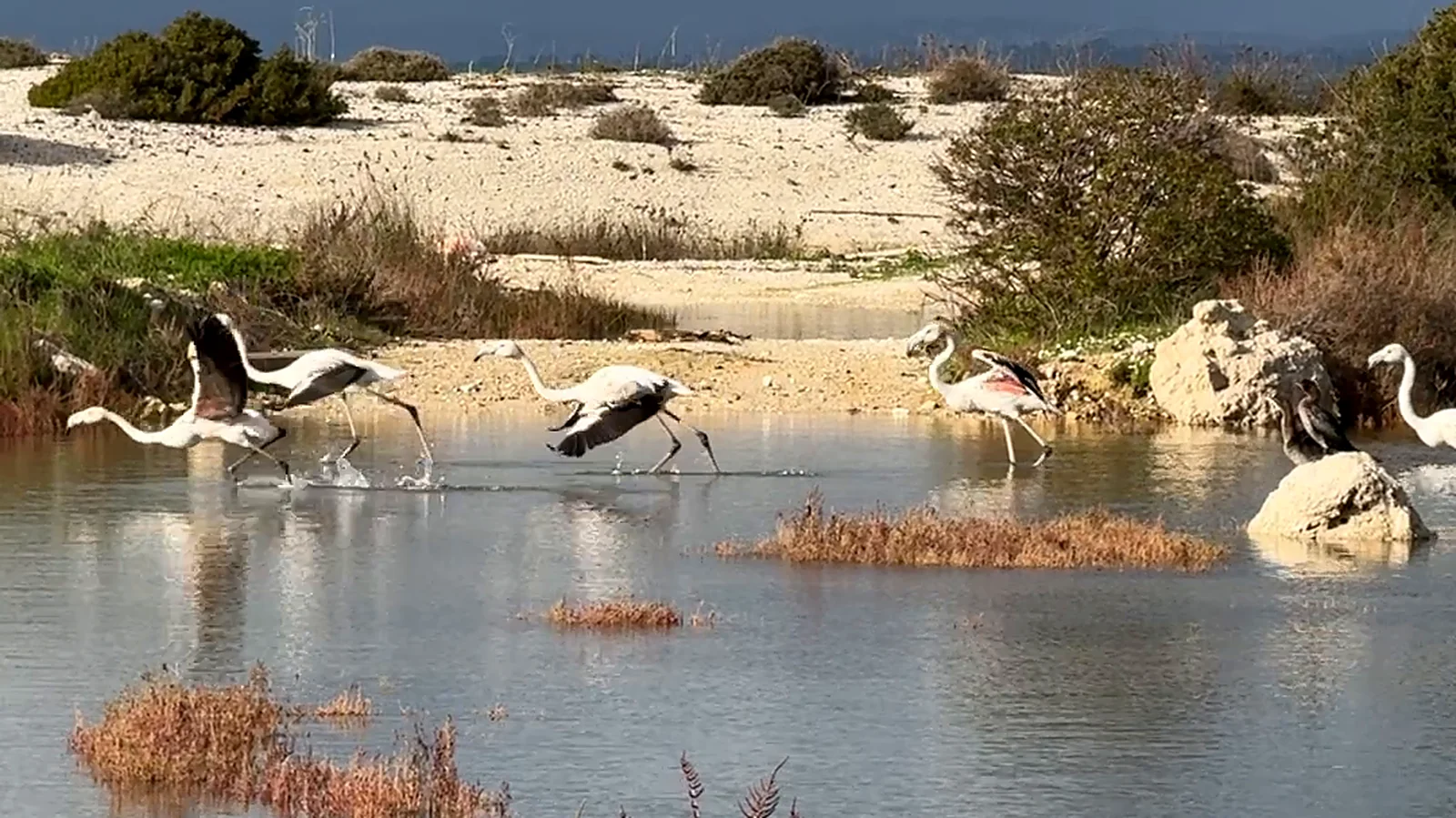
We were on the road back to the mainland when we saw them. A flock was crossing the water at a sprint, long legs splashing, necks stretched forward, wings spread wide until they lifted. Some were deep pink. Others were pale, almost white, and in the air all of them flashed black along the wing. For a few seconds it looked as if two different birds shared the same sky.
It cost nothing, and it is still one of the things we remember best from that trip.
Flamingos in Lefkada after the season
Lefkada is known for its summer: bright bays, full beaches, busy harbours. By winter the island goes quiet, and the lagoons belong to the birds. With the crowds gone, it is easy to stand still and watch them.
Why flamingos come here
Lefkada’s lagoons lie at the island’s northern edge, around the fortress of Agia Mavra, where the island almost touches the mainland. They are part of the Natura 2000 network and are also recognised under the Ramsar convention, according to the island’s official tourism site. Shallow, salty water full of small life is exactly what flamingos look for.
The birds are greater flamingos. We saw them in winter, and local reports suggest they stay from autumn through the cold months. Numbers change from week to week, so treat a sighting as a gift, not a promise.
The pink, the white and the black
What surprised us most was that the flock did not look like one kind of bird. Here is what we think we were seeing, and what it tells you:
- The pink is a diet. Flamingos get their colour from the brine shrimp and blue-green algae they feed on. Take the food away and the pink fades.
- The pale ones are young. Young flamingos are grey and white, and they turn pink slowly as they mature. A flock therefore holds every stage at once, from pale to rose to deep pink.
- The black is in the wings. The flight feathers of a flamingo are black. You barely see them while the bird stands, but the moment its wings open, white and pink bodies suddenly show black edges. This is why a flock in flight looks black and white.
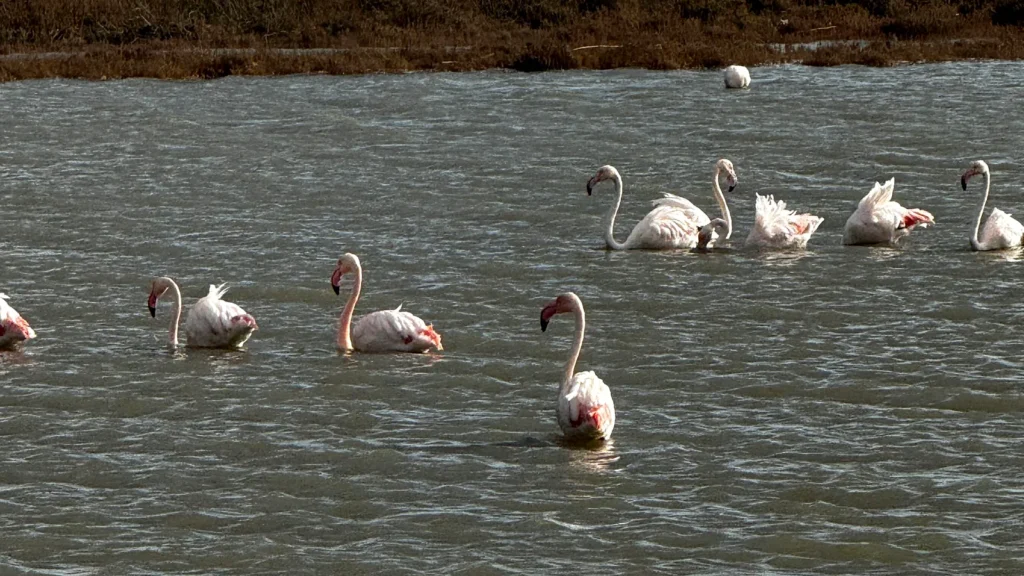
So the “black and white flamingos” are the same birds as the pink ones, caught at a different moment and a different age. It made the scene richer, not simpler.
Two things worth knowing
- They are tall and light. An adult greater flamingo is roughly 125 cm long and weighs only about 2.5 to 3.5 kilos.
- They run before they fly. The splashing sprint across the water, which we watched, is how a flamingo gets enough speed to lift off.
How to watch them well
- Keep your distance and your voice low. Flamingos feed with their heads down, and they take off at the first sign of disturbance. Every flight costs them energy in the cold.
- Leave the drone at home. It frightens birds more than anything else, and flying rules apply in protected areas. Check the official Drone Aware Greece map before any flight.
- Do not stop on the road. The strip of land near the fortress carries traffic. Park somewhere safe and watch from a distance.
- Bring binoculars or a longer lens if you have them. A phone camera shows the flock, but the detail is in the zoom.
- Come in the afternoon, when the low winter light turns the water to silver.
Who else lives here
The lagoons are not only for flamingos. The island’s tourism site lists herons, swans, gulls, ducks and geese among the birds that stop here. Gyra, the strip of white sand about 7 km long that closes the lagoon on the north side, is worth more than a drive-by.
Plan it slowly
- When to go: the cold months, from autumn into the new year.
- How long: an hour is enough to see them. A morning or an afternoon lets you walk, watch and catch the light.
- Pace: bring patience and nothing else. This is a place for standing still.
Next door: the old fortress of Agia Mavra stands close by, at the same edge of the island.
Going on through Epirus? We wrote about Ambracian prawns in Preveza and about where to base yourself in Syrrako.
We saw this ourselves. Background: lefkada.gr, Oiseaux.net, HCAA.